Meditation With a Houseplant: A Five-Minute Mindfulness Practice for Beginners
Beginners who struggle to just sit often do better with a meditation that has something to look at. Try five minutes in front of a single houseplant, attending carefully to leaf shapes, how light falls, and the moisture of the soil. This guide walks you through the practice and how to make it stick.
Why "Sitting With Eyes Closed" Fails So Many Beginners
You decide to start meditating, close your eyes, sit down—and within two minutes your head is running through "I have to reply to that email" and "I should have said that differently yesterday." You conclude, "maybe this isn't for me," and quietly give up. It is probably the single most common way beginners fail at meditation.
A big misunderstanding is hiding in there. Many people begin with the image of "meditation equals emptying the mind." That is not what meditation is. Meditation is training yourself to keep attention on the present moment, and the object of that attention does not have to be the breath. For beginners, in fact, having something concrete they can see and touch makes the practice dramatically more sustainable—something many experienced teachers know from countless students.
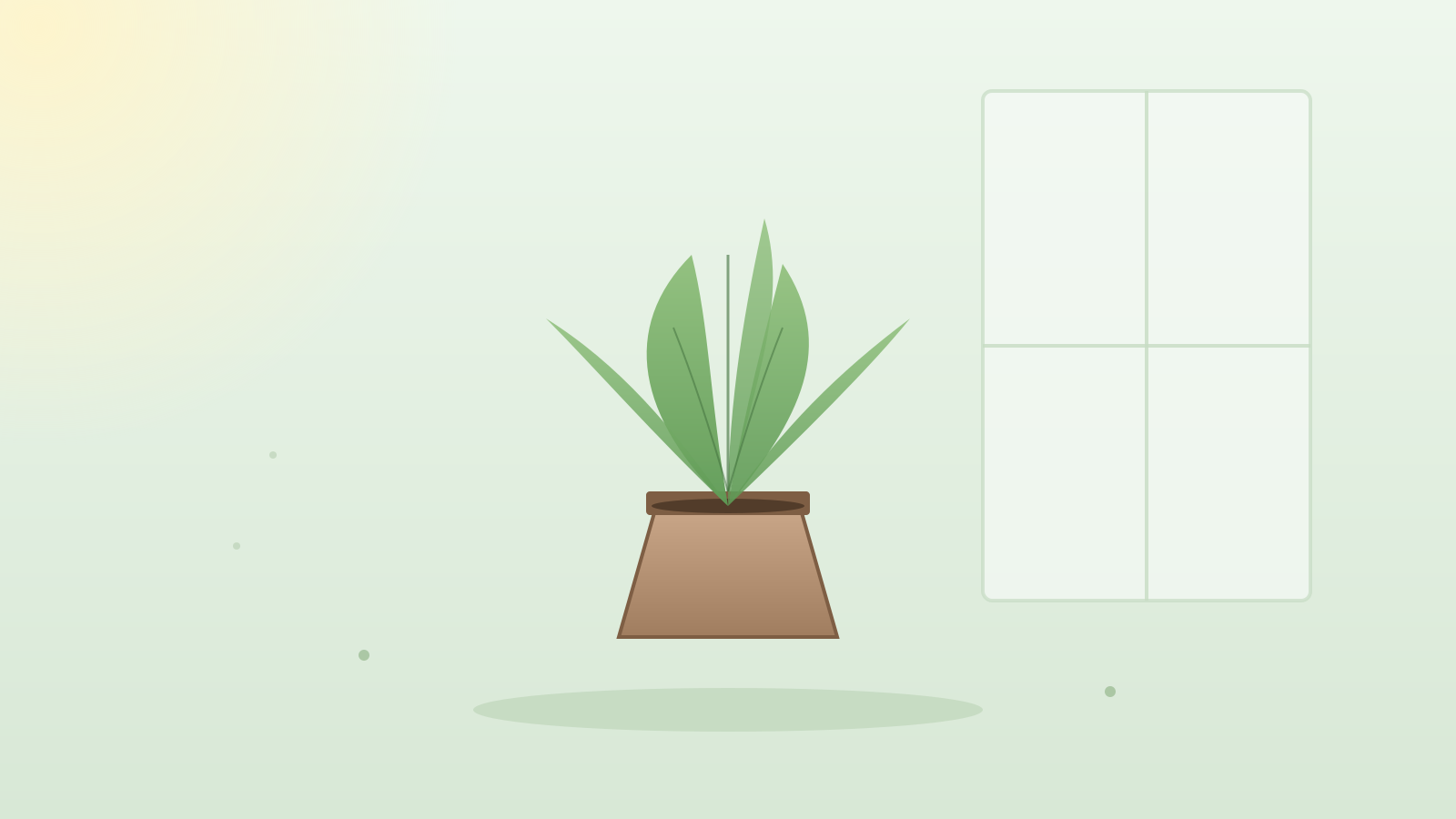
The most accessible and low-maintenance such object is a single houseplant on a windowsill. Motionless, not overly stimulating, and slowly transforming from one day to the next, it is an ideal "meditation partner" for a beginner.
Three Reasons a Houseplant Works So Well
Why a houseplant in particular? Three main reasons.
Reason 1: It changes slowly. A phone or a busy street changes second by second, pulling attention around constantly. A plant changes "by the day." A leaf unfurls, a new shoot extends, the soil dries. None of this races forward during a meditation session, and that very quietness becomes a vessel for scattered attention.
Reason 2: It is rich in concrete detail. Look closely at a single leaf: the pattern of the veins, the teeth along the edge, how the green shifts in intensity with the angle of the light, the tiny hairs on the underside, the small scar on an older leaf. Each of these holds endless detail. The richer the object of attention, the less room there is for the inner chatter to reclaim the foreground.
Reason 3: A relationship can grow. A houseplant responds when you care for it: you water, you adjust the direction of the light, you trim withered leaves. That back-and-forth care is continuous with the care you give yourself. As a meditation habit develops, your relationship with a small life form develops in parallel.
Preparation: Choosing and Placing the Plant
You do not need to buy anything new for this. Whatever plant you already have is fine. If you are starting fresh, pothos, sansevieria, peperomia, a small monstera, or pachira are all beginner-friendly: tough and easy to care for.
Three guidelines for choosing:
A size that sits near eye level. Rather than a large floor plant, a 30–50 cm specimen on a table or bay window works best for sitting practice.
Clearly shaped leaves. For an object of observation, leaf shape should be easy to read. A plant with a few distinguishable leaves is easier to watch at first than one covered in dense tiny foliage.
A healthy specimen. Sitting in front of a struggling plant inevitably pulls your attention into worry. Start with a reasonably healthy plant and let the meditation and its care evolve together.
As for placement, a windowsill with morning or evening light is ideal. Direct sun is too strong for both the plant and for you; soft light through a sheer curtain is just right.
The Practice: A Simple Five-Minute Flow
Here are the actual steps. Five minutes is enough at first. Set a timer for five minutes.
Step 1: Settle into position (about 30 seconds)
Sit on a chair or cushion 50–80 cm from the pot. Having the plant a bit below eye level allows a gently downward gaze, which is easier to relax into. Do not force the spine straight—"chin roughly parallel to the floor" is enough.
Step 2: Take three breaths (about 30 seconds)
Do not start staring at the plant right away. First give three breaths to yourself: the air entering through the nose, the slight rise of the belly, the temperature of the exhale at the nostrils. Think of it as a short preface that says "I am here."
Step 3: Take in the whole plant (about 1 minute)
Slowly open your eyes and let the whole plant come into view. Move your gaze vertically from the base of the pot to the tips of the leaves and observe the silhouette of the whole specimen. "Is it symmetrical?" "Which side holds more leaves?" "From which direction is light falling?" At this stage, receive the overall shape rather than the details.
Step 4: Choose one leaf and watch it (about 2 minutes)
Next, select a single leaf—"the one that catches your eye" or "the one you somehow feel drawn to" is fine. Take time to observe its outline, its veins, the gradient of its color, and the texture of its surface.
When thoughts arise along the way—"what intricate design," "this one looks a little bruised"—simply notice them, gently label them "thinking," and return your gaze to the leaf itself. What matters is not banishing thought but repeatedly executing the small movement of "returning to the leaf." That return is the real strength training of mindfulness.
Step 5: Feel the pot and the soil (about 1 minute)
Lower your gaze from the leaf to the pot and soil. Notice the color of the soil, its surface moisture, the rim of the pot, how the pot sits on its saucer. If possible, reach out and lightly touch the surface of the soil with a fingertip. Is it dry, cool, faintly damp? This small contact extends attention from the visual into the tactile.
Step 6: Return to the whole plant and finish (about 30 seconds)
Finally, take in the whole plant once more, linger for two breaths, and close your eyes. Feel the current state of your body and mood without labeling it. Is there a little more quiet? Or less calm than you had hoped? Either way, just acknowledge it without judgment. Slowly open your eyes, stop the timer, and the meditation is done.
A Small Personal Account—The Day I Forgot to Water It
A personal note. When I first started working from home, there was a stretch when work consumed me so completely that I forgot to water the pachira next to my desk. One evening, after finishing a meeting, I looked up and noticed the leaf tips had turned a little brown and curled. A small, quiet ache moved through my chest: "I haven't really looked at you in a while."
I stood up, watered it, breathed in the smell of the newly wet soil, and then just sat and watched the leaves for about five minutes—no timer, nothing set. Just looking. The thinness of the veins, the softened reflection of light on the surface, a small chip on the rim of the pot. Little by little, the forward-leaning posture of work mode eased back.
What I learned that evening was that meditation can be an extremely modest thing: a choice of where to put your eyes. Sometimes "really looking at something I've been overlooking" is far easier and more effective than "closing my eyes and trying to concentrate."
Three Tricks for Sticking With It
Trick 1: Fix the time and the place
"After I make my morning coffee, I carry my cup over to the plant and sit for five minutes." Attaching the practice to an existing habit makes it much more durable. This is habit stacking, a well-known technique from behavioral science: place the new habit immediately after an existing one so you do not have to rely on willpower.
Trick 2: Do not aim for "the day I focused perfectly"
A day where three of the five minutes were lost to thinking is completely fine. The meaningful metric is how many times you noticed you had drifted, not how long your focus lasted unbroken. If, in a single session, you drift and return ten times, that is already solid training.
Trick 3: Record small changes
Before and after the meditation, jot down one small observation in a notebook—about your chest, your shoulders, or the depth of your breath. "Shoulders a bit lower." "Breath a bit deeper." A stack of such small notes builds a genuine sense of "this is worth continuing."
Cautions and Extensions
A few cautions for this practice.
If you have plant allergies, or if your pollen allergy flares seasonally, ventilate the room well and avoid strongly scented species (eucalyptus, jasmine). In households with young children or during pregnancy, be aware that some popular houseplants (like dieffenbachia) have mild toxicity, and prioritize safe choices accordingly.
Once five minutes feels comfortable, you can extend to ten, or narrow the object to "a specific part of one leaf" and observe the same leaf for three days in a row. On the third day you are likely to notice small changes invisible on day one—which is direct evidence that an "eye for change" is developing in you.
A Single Plant Can Be Your First Quiet Teacher
One reason beginners stumble in meditation is that they over-idealize the "meditating self": quiet room, composed posture, mind free of thought. Those are not prerequisites; they are outcomes that gradually appear through practice.
Is there a houseplant somewhere in your home tonight? If so, when work is finished, sit in front of it for five minutes. If not, this weekend, welcome one small plant that fits in the palm of your hand. No special tools, no special time. Just look at one leaf. That is the first doorway into your meditation practice.
The plant says nothing. But during the five minutes you sit quietly, no matter how many times you look away, it remains in the same form when you return. Without a single word, it teaches the most important posture in meditation: you are always allowed to return, no matter how many times you drift.
About the Author
Meditation Guide Editorial TeamWe share practical meditation guides and techniques in a way that is easy to understand and applicable to everyday life.
View author profile →Related Articles
Visualization Meditation for Hard Choices: Rehearse Each Future to Make Confident Decisions
Morning Warm Water Mindfulness: A Five-Minute Practice to Gently Wake Body and Mind
Building a Three-Minute Bedtime Meditation Habit: Designing a Tiny Routine That Actually Sticks
Blue Light Visualization Meditation: The Calming Power of Color and How to Practice It